Here’s a fun fact: People aren’t going to listen to your 20-minute podcast unless you or your guests are big shots in your industry. Source: Trust me.
But they might be persuaded to do so if you offer them enough reason to spend 20 or more minutes of their life with your podcast. At a minimum, you should be doing short video clips of your podcasts, but there is a lot more gold to discover within your content.
What you also need is content recycling, also known as content repurposing, which involves taking your existing content and transforming it into different formats.
For a podcast, that means turning your audio episodes into written articles, social media posts, and more. The goal is to make the most out of the valuable content you’ve already created and reach a wider audience who might prefer different ways of consuming information.
Getting a podcast done is only half of the job. Marketing the podcast to your audience is the latter part that many starting podcasts struggle with, especially for businesses trying to position themselves as industry leaders.
Ultimately, content recycling is about ensuring your message gets the attention it deserves across multiple platforms.
This guide will show you some ideas on how you might want to recycle your podcast content to maximize its value and reach.
Before we move on, here are a few more tips on why you should repurpose your podcasts.
Here’s why your podcast needs recycling… NOW
Increased reach and engagement
When you repurpose your podcast content, you can connect with different audience segments across various platforms.
Some people may not have the time to listen to a full podcast episode but would gladly read a blog post summary or watch a short video clip. By offering multiple formats, you cater to different preferences and increase the chances of your content being consumed and shared.
This broader reach translates into higher engagement, more followers, and ultimately, a larger impact on your brand.
Time and resource efficiency
Creating original content from scratch can be time-consuming and expensive. By repurposing your podcast episodes, you leverage the effort already put into creating the original content. This not only saves time but also allows you to maintain a steady stream of high-quality content without overwhelming your team.
Content recycling is a sustainable approach that maximizes the return on investment for each podcast episode, making your content strategy more efficient and effective.
Enhanced SEO and online presence
Repurposing content boosts your SEO efforts by generating more opportunities for keyword usage and backlinks. Blog posts, articles, and social media updates derived from your podcast can be optimized for search engines, improving your online visibility.
A stronger online presence helps potential customers find you more easily and positions your brand as an authority in your industry. Each piece of repurposed content acts as a digital breadcrumb leading back to your original podcast, enhancing your overall digital footprint.
Identifying key themes
AI tools are developing at blazing speeds. While this guide relies on a text-based transcription, it probably isn’t too far in the future when you’ll be able to recreate a lot of these steps by simply feeding the audio recording. When that happens, I’ll probably do a new guide on how that might happen.
For now, we’ll use text tools for our content recycling purposes.
Get a Transcription of the Podcast
Ideally, you should have listened to your podcast at least once to roughly know what’s happening. But I’ll assume you are too busy for that and instead, you decide to skip straight to repurposing.
The first step should always be getting a transcript of your episode. There are multiple uses for a transcript:
– Feed it to an AI tool like ChatGPT for content ideas (we’re going to take a closer look at this).
– Build subtitles for videos.
– Quickly find that one juicy bit without constantly rewinding and fast-forwarding the podcast recording.
Now, there are also multiple ways to actually get a transcript.
– Your podcast recording platform might do transcriptions automatically, like Google Meet or Riverside.
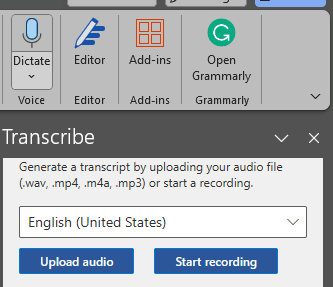
– You could upload them to a platform, which machine transcribes audio. Microsoft Word is also pretty handy at creating them, just click Home and then look for the tool on the right that says Dictate, click the arrow below it for Transcribe, upload your audio for the relevant language and you’re good to go.
Do note that industry lingo is often lost in transcription, which is especially the case when the services are trying to analyze non-native speakers or otherwise unclear accents. Although you might not get a 100% perfect copy immediately, the content should hopefully be alright to get a good enough baseline for an AI to analyze later on.
So for now, you still need to either manually edit the transcript for weird sentences or hire someone to do the work for you. I’ve been pretty happy with the translators on Fiverr as a time and cost-effective solution for (near) perfect transcripts – especially if you have a season’s worth of podcasts to transcribe in bulk.
Using AI tools with your podcast transcript
Alright. You have your podcast transcript. Let’s analyze it for key themes and segments with AI.
But wait!
I should already know all this. Why do we need AI to tell that to us?
The reason we feed the transcript to AI is to double-check that the tool understands what the podcast is about before generating content based on the transcript. You as the crafty marketer have to verify that AI isn’t hallucinating (making up stuff) so that the following content really relies on the original source material i.e. the podcast’s transcript.
Let’s continue and feed the transcript to ChatGPT (I’m using the GPT-4o model for this guide) or your choice of AI tool. You could tell it to:
“Read the attached transcript of a podcast related to technology. Provide a key summary of its contents. Include quotes from speakers to strengthen your summary.”
Depending on your podcast, you could add more information about the speaker(s) and guest(s), the podcast’s topic, and target listeners to finetune your results.
Note! AI tools have limited memory where they begin to forget the base material. However, those limitations are becoming less and less relevant with each new update. You could do the splits manually for each content segment or just let the tools do it based on length alone with tools like ChatGPT Splitter.
In the end, your result might look something like this:
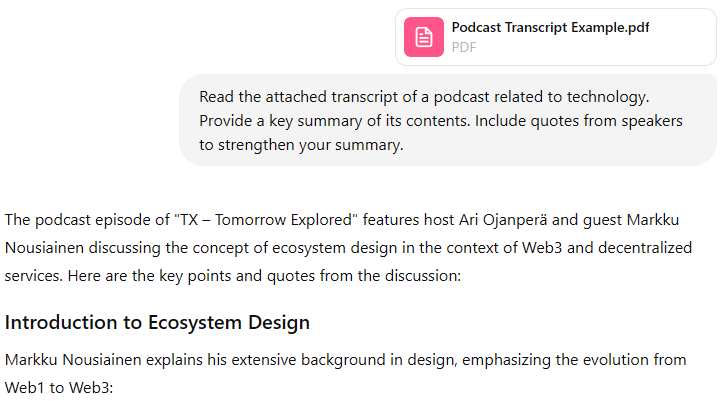
In my example, I’m using an old transcript from a podcast episode. The list goes on with a total of 6 key discussion points during the 30-minute episode. Yours might be longer or shorter – hopefully better!
So, we now have an AI content generator that is contextually aware of our podcast. It’s time to shift toward content recycling.
Creating content from key segments
This part especially is the one that you as a Marketer are paid to be a pro. While AI gave us a list of important things to talk about, you need to decide what content actually gets created. That might be based on your overall marketing strategy, a more detailed SEO or social media strategy, or just a gut feeling if you’re feeling adventurous.
Here’s a list of new material you could make with your podcast:
Knowledge articles: In-depth articles on a topic from your podcast that you can enrich with quotes from your podcast
Blog posts: Feature your company’s experts who get to voice their opinions in written and auditory form
Social media posts: Quotation lifts from the podcast, slideshow on important bits, X (Twitter) threads, writing copytexts
You could repurpose the content so that it suits your newsletters, printed media, and other publishing channels. However, not everybody does those, but having an online presence (website) and some social media activity should be a bare minimum in your marketing activities. That’s why I’ll keep the list short and simple for this guide.
Coming back to my example, ChatGPT pushed out the following topics:
Introduction to Ecosystem Design: Alright, but not really enough for long-form material.
Defining Ecosystems in Decentralization: Unless you’re doing a glossary, there isn’t much long-form potential here. But definitions could be useful for social media.
Importance of Fairness in Web3 Ecosystem: This sounds heavy and thoughtful – blog post potential.
Transition from Hype to Utility in Web3: Similar to the previous one, this could be an expert blog post or just a general knowledge article.
Evolution of Design Tools and Methodologies: I’d probably keep this as a general knowledge article that explores different design tools and methodologies.
Once you’ve completed evaluating your list, it’s time to start feeding prompts to ChatGPT (or another AI tool) to deliver content drafts. If you’re strong in your prompt game and knowledgeable in the domain, you might be able to get solid content in a short amount of time.
One good way to help your tool align its tone with your brand is to simply link or attach existing content and tell it to retain the same style. No, it won’t be perfect but it will already help you reduce time in editing unnecessarily verbose or difficult language. For example:
“Using the podcast transcript, create an article on the evolution of design tools and methodologies. I have attached a blog post on a different topic but I want you to use a similar tone of voice in your new article. Mention that the topic was also discussed in the podcast and include relevant quotations when appropriate. The article’s length should be 1,500-2,000 characters long.”
Here’s the introduction I received for the article:
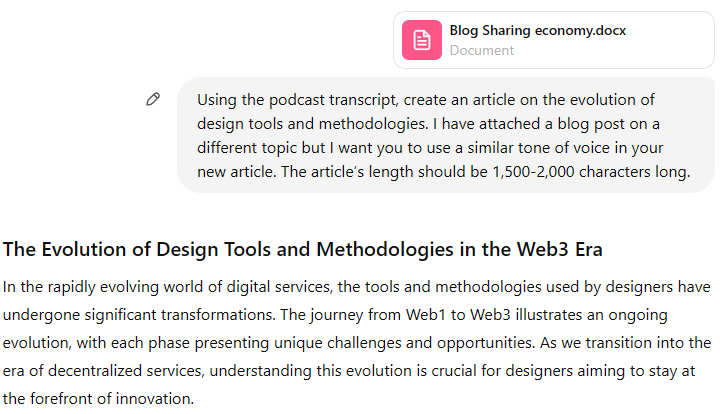
If you read it through, you’re probably not impressed. Another model might do better or you might need to adjust your prompt to get a more interesting result. We are doing content for humans, after all, not algorithms. In this case, I’d ask for the introduction to be a bit more elaborate and drop some of the tech jargon completely.
Once you get a version that you’re happy with, simply finetune the text to align with your brand and work on finishing the article like you would with any other text content.
Here are a few other prompt examples you could try out with your content:
“Mention 3 concise quotations from the guest speaker that can be used in a social media post.”
“Select three memorable sections from the podcast that can be used as individual, 30-second video clips.”
“Write an article description of the podcast using no more than 140 characters. The description is the article’s SEO metatext. Include a concise Call-to-action to open the article.”
Summary
Repurposing your podcast content into various formats is a powerful strategy to maximize its value. You might consider your podcast as “marketing content” in itself. However, new podcasts often lack marketing value until the podcast itself is well-known and established. By transforming your podcast content into articles, videos, social media posts, and more, you can extend the podcast’s reach. AI tools can accelerate this process. This approach saves time and resources and also enhances your online presence, driving more engagement and traffic to your podcast.